Introduction
The High-Throughput Screening Core (HTSC) provides investigators with access to specialized expertise, instrumentation, automation, compound libraries, and data analysis for small-molecule screening.
HTS projects vary considerably in biological system, assay format, scale, technical requirements, and scientific objectives. Accordingly, the HTSC does not employ a single standardized workflow for all projects. Experimental design, assay performance criteria, screening strategy, timelines, and deliverables are established in consultation with the investigator for each project.
Initial consult
Investigators interested in screening should contact the HTSC for an initial consultation. The purpose of this consultation is to discuss the target, assay system, screening strategy, feasibility, available controls, required reagents, and potential follow-up studies.
Following consultation, the HTSC will propose an appropriate project plan. Depending on project complexity, this may include assay development and optimization, pilot studies, assay miniaturization, primary screening, confirmation studies, dose-response analysis, counterscreens, or other follow-up experiments.
Assay development
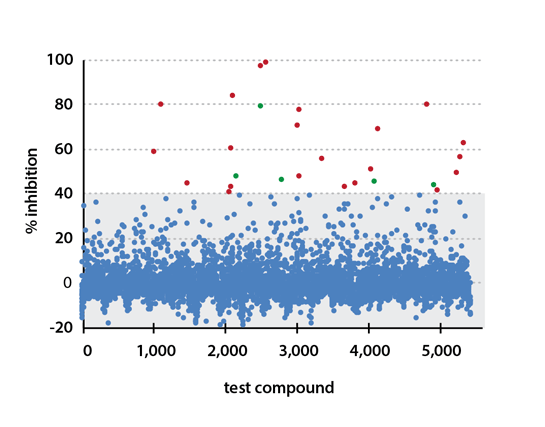
Assays must demonstrate sufficient robustness and reproducibility before large-scale screening is initiated.
Assay acceptance criteria will be determined on a project-specific basis and may include measures such as:
- Z′ factor or other statistical measures of control separation
- Intra- and inter-plate variability
- Reproducibility between experimental runs
- DMSO tolerance
- Stability of assay signal over the anticipated screening period
- Appropriate positive and negative control performance
- Assessment of positional or edge effects
- Cell growth, viability, or other biological performance criteria, when applicable
HTSC will work with investigators to determine suitable acceptance criteria before screening.
Compound Libraries
- The HTSC maintains compound collections that are available for screening subject to policies and compound availability.
- Screening concentration will be determined based on the assay and the properties of the relevant compound collection.
- Compound integrity can be affected by storage, freeze-thaw cycles, precipitation, chemical instability, and other factors. Unless otherwise specified, screening results should not be interpreted as independent confirmation of compound identity, purity, or stability.
HTS and followup
The design of each screening campaign will be determined in consultation with the investigator.
Primary screening may be followed by activities such as:
- Repeat testing of primary hits
- Concentration-response analysis
- Orthogonal assays
- Counterscreens
- Cytotoxicity or interference assays
- Selectivity studies
- Secondary phenotypic or mechanistic assays
The appropriate follow-up strategy will depend on the assay and scientific objectives.
A compound identified as active in a screening assay should be considered a screening hit, not a validated probe. Additional confirmation, including compound repurchase and characterization, is required before biological conclusions can be drawn.
Data analysis
The specific data provided to the user will depend on the project. Data may include:
- Raw instrument data
- Processed or normalized screening data
- Plate maps
- Assay quality-control metrics
- Hit lists
- Concentration-response analyses
- Summary tables and figures
- Other project-specific analyses
Data-analysis methods and hit-selection approaches will be discussed with the investigator as appropriate.
Fees and estimates
Fees may include staff effort, instrument usage, compound handling, consumables, specialized reagents, data analysis, and other project-specific costs.
Assay development and optimization are experimental processes, and successful development of a screening-compatible assay cannot be guaranteed. Work performed during assay development may therefore be billable regardless of whether the assay ultimately progresses to screening.
Rates and billing practices are established according to University of Illinois System Government Costing policies.